“Updated March 2026 with FRRO registration rules, full permit requirements, and return shipping guide”
Planning an international bike trip from India? Learn if foreign nationals can take an Indian registered motorcycle across borders and what is legally possible.
So You Want to Buy a Indian Registered Motorcycle and Ride It Out of the Country.
The complete, unfiltered truth for foreign nationals — what’s possible, when FRRO registration lets you own the bike yourself, what’ll land your Indian friend in jail, and how to do this the right way.
Read time 14 min | Route India → Nepal → Tibet → Norway | Updated March 2026
Every year, hundreds of foreign nationals arrive in India with the same dream: buy a Royal Enfield, point it toward the Himalayas, and just… keep going. Nepal. Tibet. Central Asia. Europe. The open road, forever.
It’s a beautiful dream. It’s also one of the most legally complicated things you can attempt as a foreigner on Indian soil — and most of the blog posts you’ll find online gloss over the parts that can get you detained at a border, bankrupt your Indian friend, or leave your motorcycle impounded in a country where you don’t speak the language.
This isn’t that kind of blog post. This is the real guide — built from Indian motor vehicle law, customs regulations, Carnet de Passage rules, and the hard lessons of riders who’ve done it before. Read all of it before you buy anything.
“The biggest mistake isn’t the route. It’s not understanding whose name is on the registration — and what that actually means when you cross a border.”
Can a Foreigner Even Buy and Register a Motorcycle in India?
Let’s start with the foundational issue that most people don’t research until it’s too late.
The short answer: technically yes, but with conditions most foreign tourists cannot meet.
Under the Motor Vehicles Act, 1988, and the Central Motor Vehicles Rules, 1989, a vehicle can only be registered in India by a person who has a valid Indian address proof. This means a rental agreement, utility bill, or official address confirmation — not your hotel booking.
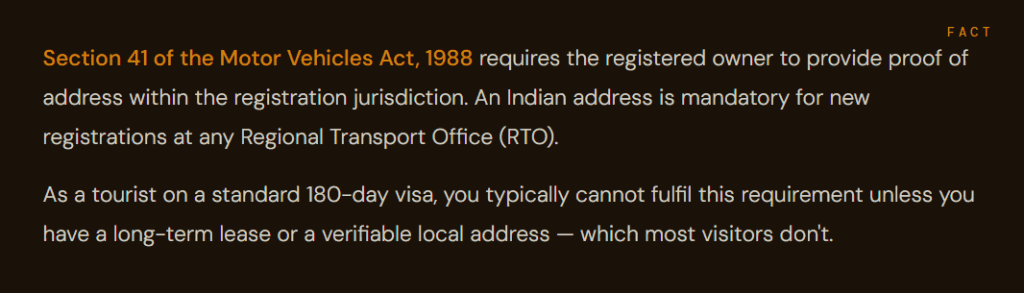
So what do most overlanders actually do? They buy the bike in a trusted Indian friend’s name, get a notarised authorization letter to ride it, and hit the road. It works in India. The moment you try to cross a border, everything changes.
✓ Valid IDP (International Driving Permit) — your home country licence is NOT valid on Indian roads without this. Obtain before arrival.
✓ Registration Certificate (RC) — original document in the registered owner’s name. Carry always.
✓ Third-Party Insurance — mandatory under Indian law; comprehensive cover strongly recommended.
✓ PUC Certificate (Pollution Under Control) — emissions compliance; renewable every 6 months at petrol stations.
! Notarised Authorization Letter from the registered owner — legally not mandatory in India, but without it you will be stopped, questioned, and potentially detained by police who assume the bike is stolen.
Can You Register the Bike in Your Own Name? The FRRO Route Explained
Here’s the question most overlander blogs never address: what if you’re not just a tourist passing through? What if you actually live in India on a long-term visa? Does that change your ability to register a vehicle in your own name?
Yes — and this changes everything.
The FRRO (Foreigners Regional Registration Office) is the arm of India’s Ministry of Home Affairs that manages the registration and monitoring of foreign nationals on long-term visas. If you are in India on a qualifying long-term visa and register with the FRRO, the certificate you receive is a central government-issued document carrying your verified Indian residential address.
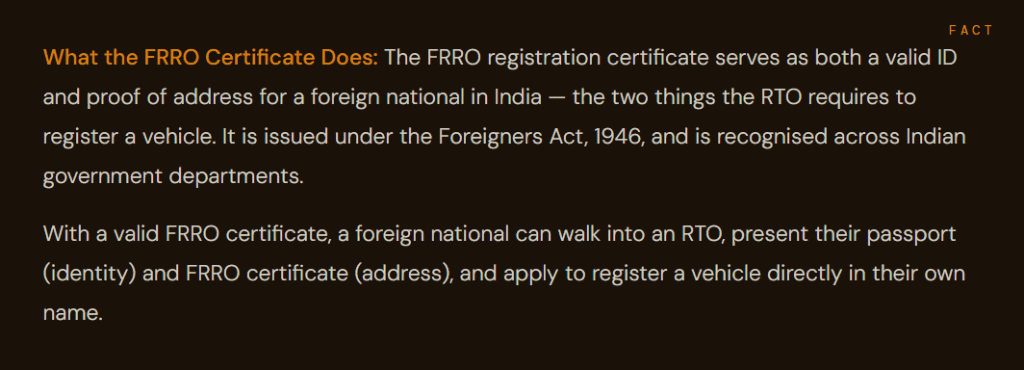
Who Qualifies for FRRO Registration?
Not every foreign national in India qualifies. FRRO registration is mandatory — and therefore available — only for specific visa categories. The rule is simple: if your visa is valid for more than 180 days, you almost certainly need to register with the FRRO within 14 days of arrival.
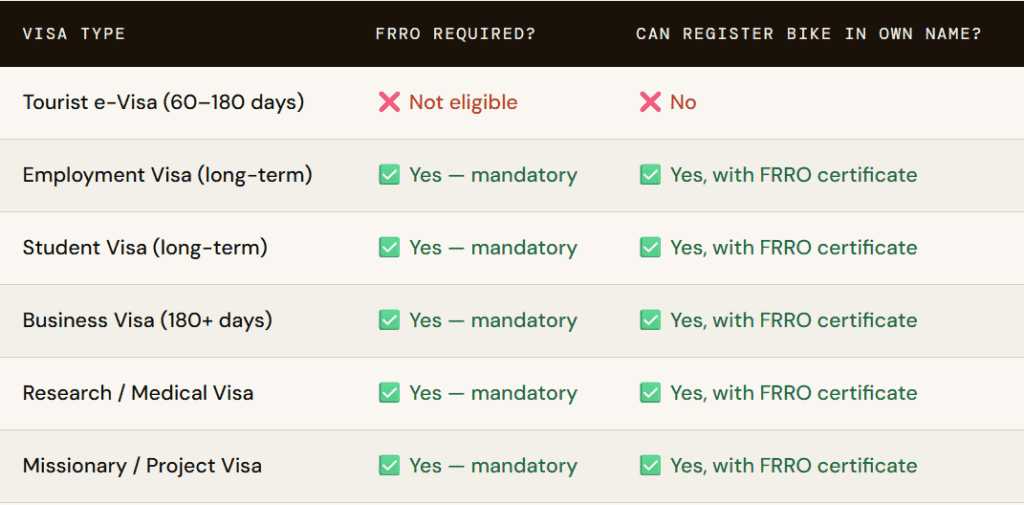
If you’re in India on a standard tourist e-Visa — even a 180-day one — you are not eligible for FRRO registration. You cannot use this route to register a vehicle in your own name. The friend-ownership model from Section 01 applies to you.
Why This Matters So Much for the Overland Trip
If you qualify for FRRO and register the bike in your own name, the entire legal structure of your trip simplifies dramatically:
✓ You apply for the Carnet yourself. No friend’s name on the application, no Power of Attorney complexity, no deposit risk to someone else.
✓ The RC, Carnet, and insurance all match your name. This eliminates the most common reason border officials create problems — a name mismatch between the rider and the documents.
✓ You control the return. You close the Carnet, you handle customs clearance, you get the deposit back — no coordination with a third party.
✓ No criminal liability risk for anyone else. If anything goes wrong with the bike abroad, it’s your legal issue alone — not your Indian friend’s.
India’s RTOs operate with significant state-level discretion. RTOs in Delhi, Mumbai, Bengaluru, and Hyderabad — cities with large expat populations — are experienced with FRRO-based registrations. Smaller or rural RTOs may push back from unfamiliarity alone. If you face resistance, a local RTO agent or transport lawyer can smooth the process significantly. The law is on your side; it’s just a matter of which official you encounter.
One Critical Condition — Your Visa Must Stay Valid
The FRRO certificate is tied to your visa status. If your visa expires and is not renewed, your FRRO registration lapses. This doesn’t automatically void your vehicle registration, but it creates legal complications — particularly if you’re abroad with the bike when it happens. If you’re planning a year-long ride, verify that your visa validity covers the full duration of the trip. Many Employment and Business visas can be extended through the FRRO itself.
The Carnet de Passage — Your Motorcycle’s International Passport
If you take away one thing from this entire article, make it this: you cannot legally take an Indian-registered vehicle out of India without a Carnet de Passage en Douane (CPD). No exceptions.
A Carnet is a customs document that acts as an international guarantee. Each country you enter stamps it on the way in and on the way out. This system tells customs authorities worldwide: “This vehicle was temporarily imported. It will leave again. The issuing organisation guarantees any unpaid duties if it doesn’t.”
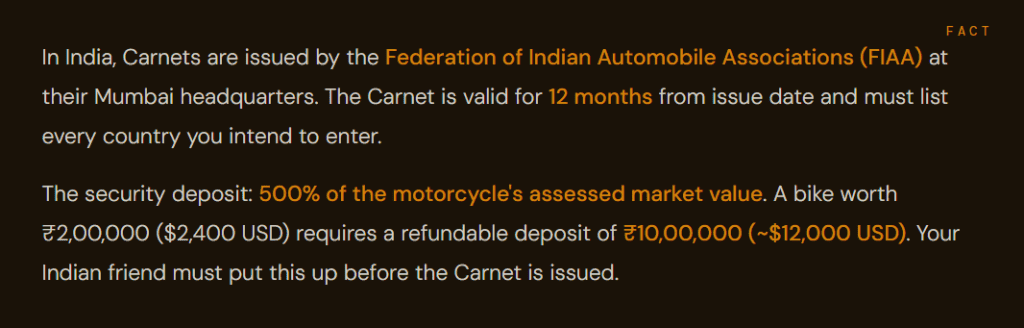
“The Carnet deposit isn’t a fee. It’s a guarantee. Bring the bike home with all stamps, and every rupee comes back.”
The person who applies for the Carnet does not have to be the rider — but they do need to be the registered owner, or hold a notarised Power of Attorney from the owner. It is strongly recommended that both the owner’s name and the rider’s name appear on the Carnet — some border officials will refuse entry if the rider and the Carnet name don’t match.
If you ride the bike out of India without a valid Carnet, you are in violation of the Customs Act, 1962. The vehicle can be seized at any border. Your Indian friend — as the registered owner — can face a criminal case for export without documentation. This is not a grey area.

The Route, Segment by Segment — What Actually Happens at Each Border
🇳🇵 India → Nepal
This is the easiest international crossing on the route. Indian-registered vehicles cross Nepal’s borders regularly. The process is called Bhansar — you pay a customs deposit at the border and receive a time-limited pass for the vehicle.
Indian-registered vehicles can stay in Nepal for a maximum of 30 days per calendar year. Overstay, and your vehicle is legally classified as smuggled and can be seized by Nepali customs — regardless of your Carnet status.
Nepal visas are available on arrival for most nationalities ($30–$50 USD). The crossing itself — Sunauli, Raxaul, or Kakarvitta are the most common for overlanders — takes 1–3 hours if paperwork is in order.
🇨🇳 Nepal → Tibet → China
This is where the fantasy meets the bureaucracy. Tibet is the most heavily restricted overland motorcycle destination on earth for foreign nationals. There is no workaround, no “local knowledge” shortcut, no overlander trick. The rules are absolute and enforced.
Every single one of the following permits is mandatory. Missing any one of them means you’re not entering Tibet.
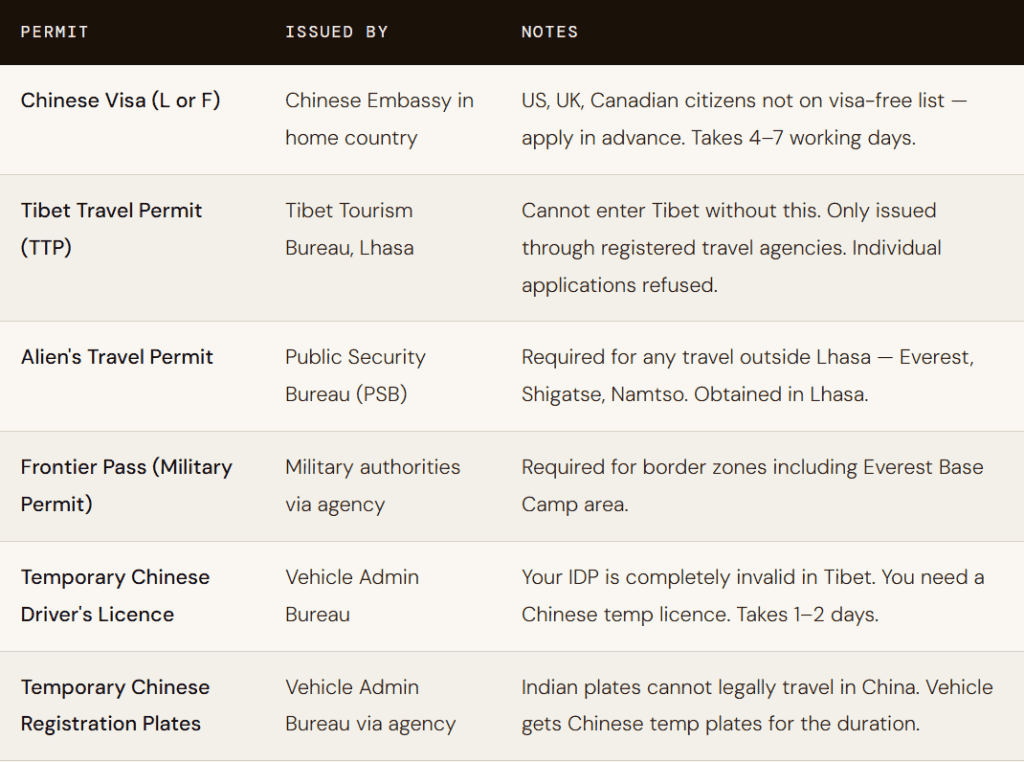
Foreign nationals cannot ride through Tibet unaccompanied. A state-licensed guide must accompany you for the entire journey through Tibet. This is enforced at checkpoints every 50–150km on major routes. The guide is not optional and not negotiable — they are a legal requirement under Tibet Tourism Bureau regulations.
You must hire a registered Chinese travel agency to handle the permit stack, the guide, the temporary licence, and the temporary plates. Budget $2,000–$5,000 USD for this segment alone, excluding your own travel costs.
🌏 China → Central Asia → Caucasus → Europe
After Tibet, the route exits through Xinjiang into Kazakhstan or Kyrgyzstan — one of the great overland motorcycle corridors of the world. The roads are long, services are sparse, and the scenery is extraordinary.
| Country | Visa (Most nationalities) | Vehicle | Key Note |
|---|---|---|---|
| Kazakhstan | e-Visa, 30 days | TIP at border | Good roads, fuel widely available, very motorcycle-friendly |
| Kyrgyzstan | Visa on arrival (many nationalities) | TIP at border | Spectacular mountain routes; Bishkek to Osh is legendary |
| Uzbekistan | e-Visa available | TIP + registration | Police checkpoints frequent; carry all docs at all times |
| Tajikistan | e-Visa + GBAO permit for Pamir | TIP at border | The Pamir Highway — world-class, but fuel is scarce on the plateau |
| Georgia | Visa-free (most Western nationalities, 1 year) | Free import, 90 days | Best country in the Caucasus for overlanders; fantastic roads and people |
| Turkey | Visa-free (US, UK, EU — 90 days) | TIP at border | Insurance required; Turkish border process is efficient |
| Bulgaria / EU Schengen | No visa for most Western nationalities | Green Card insurance mandatory | Indian bike insurance policies are invalid in the EU. Arrange Green Card before entry. |
| Norway | Schengen zone, no visa | Green Card + roadworthiness | Road tolls via AutoPASS; fuel expensive but roads excellent |
Avoid Russia entirely for now. The overland route through Russia (Siberia → Moscow → Finland) has been effectively closed to most Western nationalities since 2022. The Caucasus route — Georgia, Azerbaijan, Turkey — is the current standard.
What Happens to the Bike at the End? And What Happens to Your Friend?
Here’s where most trip planning falls apart. You reach Norway, the adventure is over — now what happens to the motorcycle?
You have three realistic options. One of them is illegal. One of them is almost impossible. One of them is the right answer.
❌ Option A: Just Leave the Bike in Norway (Don’t Do This)
If the bike doesn’t return to India and the Carnet isn’t properly closed, here is exactly what happens:
! FIAA forfeits the entire security deposit — up to ₹10 lakh+ — and pursues recovery from the registered owner (your Indian friend).
! Indian Customs issues a show-cause notice and demand for unpaid import duties to the registered owner.
! Under the Customs Act, 1962, failure to re-export a vehicle after temporary export constitutes a smuggling offence — a criminal charge, not just a civil penalty.
! Your friend faces fines, travel bans, and potential criminal proceedings in India — for a bike you rode and left abroad.
! Registering the bike in Norway is virtually impossible — Indian-spec motorcycles do not meet EU Whole Vehicle Type Approval (WVTA) standards and cannot be legally registered in any EU/EEA country.
✅ Option B: Ship the Bike Back to India (The Right Way)
This is how the Carnet system is designed to work. You ride out, you ship back, your friend gets their deposit returned in full. Here is the exact process:
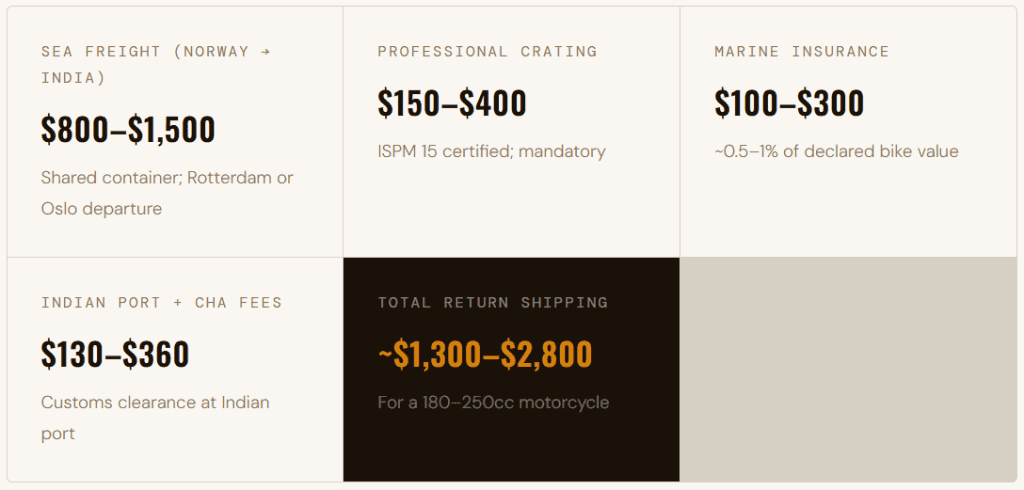
Contact a freight forwarder in Oslo or arrange trucking to Rotterdam (Europe’s largest port). Allow 2–3 weeks for booking and crating. Don’t arrive in Oslo and then start searching — rates go up, slots disappear.
At the point of export, Norwegian customs stamps your Carnet out of Norway (and effectively out of the Schengen zone). These stamps are the proof that the bike left legally. Do not skip this step.
Drain the fuel tank to near-empty (shipping regulations). Disconnect the battery. Remove all loose accessories — mirrors, GPS, luggage. Have the bike professionally crated using ISPM 15-certified fumigated timber (required for all international wood packing).
Standard sea freight from Northern Europe to India takes 6–10 weeks. The bike arrives at Nhava Sheva (Mumbai) or Chennai port. Arrange marine transit insurance — typically 0.5–1% of the bike’s declared value.
A Custom House Agent (CHA) handles the port clearance on your friend’s behalf. Since this is a re-import of an Indian-registered vehicle (not a fresh import), no new customs duties apply — the bike is just coming home. CHA fees: ₹5,000–₹20,000.
With all stamps intact, the completed Carnet goes back to FIAA in Mumbai. They verify all countries were properly exited and release the full security deposit to your friend. Transaction complete. Everyone happy.
⚡ Option C: Transfer Ownership Before the Trip
There is a third, cleaner option that many overlanders miss: transfer the bike to a new Indian owner before you leave. That new owner applies for the Carnet in their name, pays the deposit, gives you authorisation to ride — and your original friend walks away with zero liability from Day 1.
The transfer requires Forms 29 and 30 at the RTO, a Transfer Deed signed by both parties, clearance of all pending challans, and notification to the RTO within 14 days. Once the RC is updated in the new owner’s name and they apply fresh for the Carnet, your friend is legally done. No deposit risk, no criminal exposure, nothing.

What This Trip Actually Costs — Budget Breakdown
Most overlander blogs show you the fun numbers. Here are all the numbers.
| Cost Item | Estimate | Notes |
|---|---|---|
| Carnet de Passage security deposit | ₹5L–₹15L ($6k–$18k) | Refundable; based on 500% of bike value. Friend’s capital locked until Carnet is closed. |
| Carnet application + processing fee | ₹3,000–₹8,000 | Non-refundable FIAA processing fee |
| Nepal Bhansar customs deposit | ₹5,000–₹15,000 | Refunded at exit if within 30 days |
| Tibet travel agency + mandatory guide | $1,500–$4,000 | Non-negotiable. No agency = no Tibet. |
| Tibet permit stack (all permits) | $200–$500 per person | TTP + Alien’s Permit + Frontier Pass |
| Temp Chinese driving licence + plates | $100–$300 | Arranged through agency |
| Central Asia visas (4–5 countries) | $150–$400 | e-Visa fees; varies by nationality |
| European Green Card insurance | $200–$500 | Mandatory for EU/Schengen. Indian policies invalid in Europe. |
| Return sea freight (Norway → India) | $1,300–$2,800 | Includes crating, freight, insurance, Indian CHA |
| Total trip overhead (excl. daily costs) | ~$5,500–$10,000+ | Plus daily living, fuel, accommodation, food across ~15,000–20,000 km |
The Carnet deposit alone — ₹10 lakh for a mid-range bike — is not money you or your friend can simply “tie up” for a year. Plan carefully, have the conversation honestly, and explore whether a smaller-value bike makes the deposit more manageable.
Everything You Need — In the Order You Need It
→ Step 1: Decide ownership structure. Are you in India on a long-term visa (Employment, Student, Business, Research)? If yes, check if you qualify for FRRO registration — if you do, you can register the bike directly in your own name (see Section 02). If you’re on a tourist visa, the bike must be in a trusted Indian person’s name.
→ Step 2: Get your IDP. Apply through AAA (USA), AA (UK), or equivalent in your home country before you arrive in India. Without this, you cannot legally ride in India or at most international borders.
→ Step 3: Apply for the Carnet. Contact FIAA Mumbai. Start this 4–6 weeks before departure — the deposit verification and document checks take time.
→ Step 4: Apply for Chinese Visa. Must be done at a Chinese Embassy or Consulate. Apply at least 3–4 weeks in advance. Specify your entry point (Gyirong from Nepal is the primary Tibet land crossing for overlanders).
→ Step 5: Book a registered Tibet travel agency. They will handle your TTP, guide, and temp licence/plates. Do not attempt to arrange permits independently — it’s not possible for the TTP.
→ Step 6: Arrange Central Asian visas. Kazakhstan, Kyrgyzstan, and Uzbekistan are all e-Visa countries. Tajikistan’s GBAO permit (for Pamir Highway) must be added to the Tajik e-Visa application.
→ Step 7: Arrange European Green Card insurance. Before entering Bulgaria (first EU country on most routes), you need a Green Card — an international insurance certificate. Arrange this in Turkey or Georgia.
→ Step 8: Plan the return shipping from Norway. Research freight forwarders before you leave India. Know your destination port (Nhava Sheva or Chennai) and who will handle Indian customs clearance.
✓ Step 9: Close the Carnet on return. Verify all stamps are present and submit the Carnet to FIAA within 30 days of the bike’s return to India. Deposit is refunded to the registered owner.
The Bottom Line
Riding a motorcycle from India to Norway is one of the great overland adventures left on this planet. It is doable, it has been done, and if you plan it properly — with the Carnet, the permits, the agency in Tibet, and a clear return plan for the bike — it is also legal from end to end.
What it is not is simple, cheap, or something you can improvise at a border crossing. The system is rigid where it is rigid, and no amount of traveller charm will open a Tibetan checkpoint without a Tibet Travel Permit and a licensed guide standing next to you.
Do it right, and your Indian friend gets their deposit back, their RC is clean, and you have the story of a lifetime. Do it carelessly, and someone ends up with a criminal case under the Customs Act, 1962.
If this is your first time riding in India, read our
Step-by-Step Guide for Foreign Nationals to Rent a Motorcycle in India
Plan well. Ride far.
This article is for informational purposes only and does not constitute legal advice. Vehicle import/export regulations, visa requirements, and customs rules change frequently. Verify all requirements with the relevant embassies, FIAA (Federation of Indian Automobile Associations, Mumbai), and customs authorities before departure. For country-specific legal advice, consult a qualified lawyer in the relevant jurisdiction.