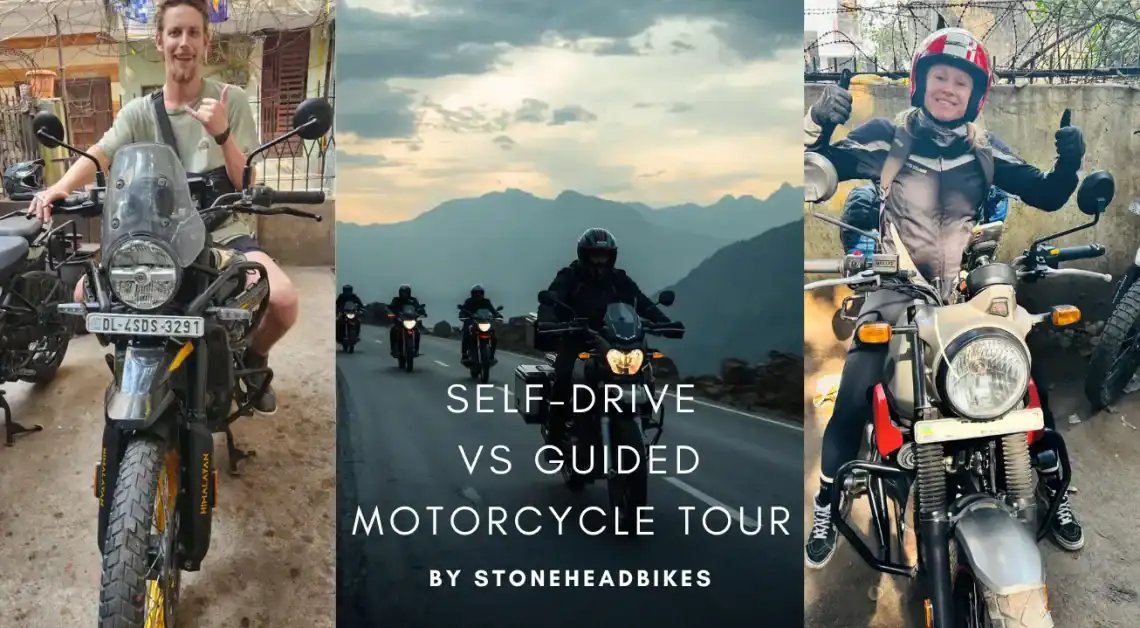
Self-drive vs guided motorcycle tour India is the question every foreign rider ends up wrestling with sooner or later — usually around 2 a.m. local time, scrolling through five browser tabs of conflicting forum advice. Do you rent a Royal Enfield and go it alone, or hand the trip to a guide and ride in a supported group? One thread swears self-drive is the “only real way to see India.” The next says anyone who rides Ladakh without backup is asking for trouble. Both are right, and both are wrong, depending entirely on who’s asking.
This isn’t a rehash of what documents you need or which bikes are available — we’ve already covered that in detail elsewhere. This is about the decision itself: the one riders are actually agonizing over before they book anything.
Quick answer, if you’re short on time:
| Self-Drive Rental | Guided Tour | |
|---|---|---|
| Best for | Riders with prior multi-day touring experience | First-time visitors, solo travelers, high-altitude routes |
| Cost | Lower per day | Higher, but covers backup and support |
| Flexibility | Full control over pace and route | Fixed itinerary, shared pace |
| Breakdown / emergency support | Self-managed | Mechanic and support vehicle included |
| Best route type | Rajasthan, Golden Triangle, low-altitude circuits | Leh-Ladakh, Spiti, high-altitude Himalayan passes |
| Social element | Solo or small private group | Built-in group of fellow riders |
The rest of this guide breaks down exactly why each of these holds true.
The Question Behind the Question
“Self-drive or guided tour” sounds like a logistics question. It isn’t. Underneath it, most foreign riders are really asking three things: Can I actually handle this? What happens if something goes wrong? And will I regret not having the freedom to just stop wherever I want?
Those three questions pull in opposite directions, which is exactly why the decision feels harder than it should. Freedom and safety net are a genuine trade-off in India — not because the country is unusually dangerous, but because it’s unusually variable. A road that’s smooth tarmac in Punjab can turn into a landslide-scarred goat track two hours into Himachal. A mechanic who fixes your chain in ten minutes in Manali might be a three-hour tow away in the Nubra Valley. Neither option “solves” that variability. They just handle it differently.
What Self-Drive Rental Actually Gives You
In the self-drive vs guided motorcycle tour India decision, renting your own motorcycle and riding solo (or with a couple of friends, unguided) means you own every decision on the trip. You leave when you want, you detour when a village looks interesting, you cut a day short if you’re tired, and you don’t share a support van with six strangers whose pace doesn’t match yours.
It also means you own every problem. If you take a wrong turn near an inner-line permit checkpoint, you’re the one explaining yourself to the officer. If your Himalayan 450 throws a warning light at 13,000 feet with no signal, you’re the one figuring out whether to push on or wait for a passing truck. Riders who’ve done this before will tell you it’s rarely as dramatic as it sounds — India’s highway network of dhabas, mechanics, and fellow bikers is more forgiving than people expect — but it does require a rider who’s comfortable being the only adult in the room when something unplanned happens.
Self-drive tends to be the right call for riders who’ve already done at least one serious multi-day motorcycle trip somewhere, who are confident reading a map and a mechanic’s hand gestures in equal measure, and who value the ability to change plans mid-route more than they value having someone else worry about logistics.
What a Guided Tour Actually Gives You
On the other side of the self-drive vs guided motorcycle tour India equation, a guided tour flips the ownership. Someone else has already ridden the route, knows which dhaba has the clean toilets and which mountain pass closes by 3 p.m., and travels with a support vehicle carrying spare parts, a mechanic, and your luggage. If you drop your bike on a hairpin bend or get altitude sickness in Sarchu, there’s a plan for that already, and it doesn’t involve you making decisions in a language you don’t speak.
What you give up is spontaneity. The itinerary is set before you land. If the group wants to leave at 7 a.m. and you’d rather sleep in, you’re leaving at 7 a.m. For a first-time visitor to India — someone who’s never ridden in a country where lane markings are treated as a suggestion and cows are treated as right-of-way — that structure isn’t a limitation, it’s the entire point. It’s the difference between learning to ride in traffic with an instructor next to you versus learning by finding out the hard way.
Guided tours also solve a problem self-drive can’t: they turn a solo trip into a social one. Riders who join without knowing anyone routinely leave with a group of friends they’re already planning a return trip with — something worth factoring in if you’re traveling alone and don’t love the idea of eating dinner by yourself in a Himalayan village every night for two weeks.
Self-Drive vs Guided Motorcycle Tour: The Real Trade-offs
Cost. Self-drive rental is cheaper per day, sometimes by half or more, because you’re not paying for a guide, a support vehicle, fuel for that vehicle, or a mechanic’s time.
But that comparison only holds if nothing goes wrong. A single breakdown in a remote stretch, a missed permit, or a wrong turn that costs you a hotel booking can close the gap fast.
Risk exposure. This is the one riders underestimate most. It’s not about whether India is safe to ride — thousands of foreign riders do it every season without incident. It’s about who absorbs the cost of the unexpected.
On a guided tour, that cost is spread across the group and handled by people who’ve solved it before. Solo, it’s yours alone, which is fine if you’re the kind of traveler who finds that reassuring rather than stressful.
Altitude and remoteness. This matters more than most other factors and gets buried in generic comparisons. On low-altitude routes like Rajasthan or the Golden Triangle, self-drive is low-risk even for a moderately experienced rider — good roads, frequent towns, strong phone signal.
On high-altitude routes like Leh-Ladakh or Spiti, the margin for error shrinks. Thinner air affects both rider judgment and bike performance (see the CDC’s guidance on high-altitude travel and altitude illness for how seriously medical authorities take this), medical help can be hours away, and mountain weather changes faster than forecasts update.
Riders comfortable self-driving in Rajasthan sometimes shouldn’t self-drive Ladakh on their first Himalayan trip — not because they can’t handle a motorcycle, but because altitude sickness and mechanical trouble compound each other at 17,000 feet in ways that are hard to picture until you’re up there. Our altitude sickness prevention guide goes deeper into managing that risk either way you ride.
Permit logistics add another layer at altitude — Ladakh, Spiti, and other border-adjacent regions require Inner Line Permits that trip up self-drive riders more often than guided groups, whose operators handle the paperwork in advance. Our Ladakh permit guide for foreign riders covers what self-drive riders need to arrange themselves.
Pace and personality. Some riders want to ride 220 kilometers a day and be done by 2 p.m. so they can explore on foot. Others want to average 90 kilometers because they keep stopping for photos, chai, and conversations with locals.
Self-drive accommodates both. A guided tour accommodates the group’s average, which may not be yours.
A Quick Way to Decide
Still weighing self-drive vs guided motorcycle tour India for your own trip? If most of these sound like you, self-drive rental is probably the better fit: you’ve ridden multi-day trips before, you’re comfortable navigating without a fixed plan, your route stays below serious altitude (or you’ve ridden at altitude before), and you’d rather solve a problem yourself than wait for someone else to.
If most of these sound like you instead, a guided tour will likely serve you better: this is your first time riding in India, your route includes high-altitude Himalayan passes, you’re traveling solo and would enjoy company, or your priority is experiencing the ride rather than managing it.
There’s also a middle path worth knowing about, and it’s one a lot of returning riders eventually land on: do a guided tour the first time to learn the terrain, the permit process, and the riding style — then come back and self-drive the second time with everything you learned still fresh. It’s a genuinely common pattern among riders who fall in love with India on trip one and want more freedom on trip two, and it’s arguably the smartest way to approach self-drive vs guided motorcycle tour India if you’re not in a hurry to decide for good.
The Bottom Line: Self-Drive or Guided, Not Better or Worse
There’s no universally “correct” answer to self-drive vs guided motorcycle tour India — whatever a forum thread might insist. Self-drive rewards riders who want ownership of every mile and are equipped to handle whatever that ownership demands. Guided tours reward riders who want the ride without the risk of also managing the trip. The honest answer to “which one should I pick” isn’t about which is better — it’s about being clear-eyed on which kind of traveler you actually are before you commit two weeks and a plane ticket to finding out.
If you’re leaning toward going it alone, our motorcycle rental guide for foreign nationals covers exactly what you’ll need to get on the road legally and safely. If a supported ride sounds like the better start, our guided motorcycle tours run across Ladakh, Spiti, Rajasthan, and beyond, with a mechanic and support vehicle on every trip. Either way, the mountains aren’t going anywhere — the only wrong choice is not going at all.
FAQs
Is it safe for a foreigner to self-drive a motorcycle in India? Yes, for riders with prior multi-day riding experience and realistic expectations about traffic, road conditions, and remoteness. It’s a different kind of safe than home-country touring — less about traffic rules and more about self-sufficiency — which is why experience level matters more than nationality here.
Is a guided tour worth it if I’ve ridden motorcycles for years? It depends on your India experience specifically, not your general riding experience. Even seasoned riders often choose a guided first trip through high-altitude Himalayan routes simply because local permit rules, altitude management, and route knowledge take a season or two to learn firsthand.
Which is cheaper: rental or guided tour? Self-drive rental costs less per day on paper. Factor in the risk of unplanned costs — breakdowns, missed permits, extra nights from delays — and the gap narrows, especially on remote, high-altitude routes.
Can I switch from a guided tour to self-drive partway through? Not typically mid-trip, since guided tours run as a fixed group with shared logistics. Many riders instead do a guided tour on their first India trip and return later to self-drive once they know the terrain.
Do I need a guide for Leh-Ladakh specifically? Not legally, but it’s the route where a guide’s value is highest, given the altitude, sparse mechanical support, and unpredictable mountain weather. First-time Himalayan riders are generally better served starting guided.